
No products in the cart.
Seamlessly Shipping all over Pakistan.
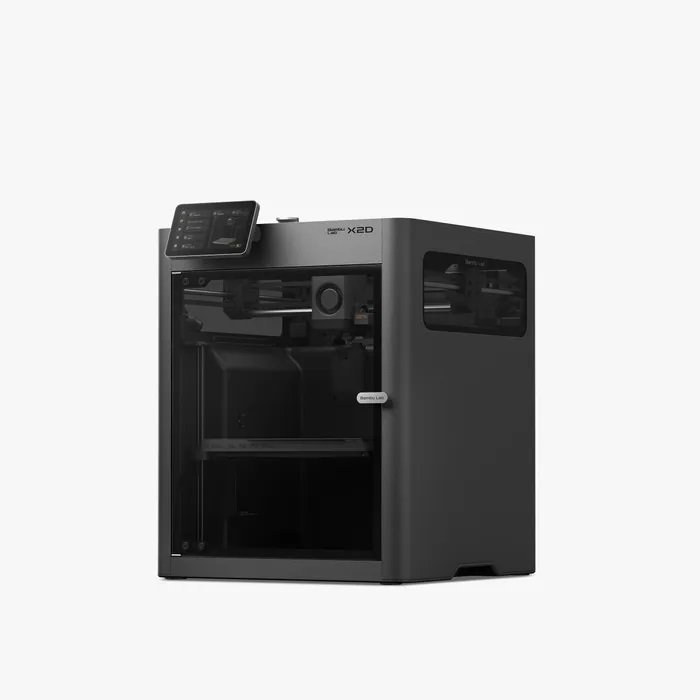
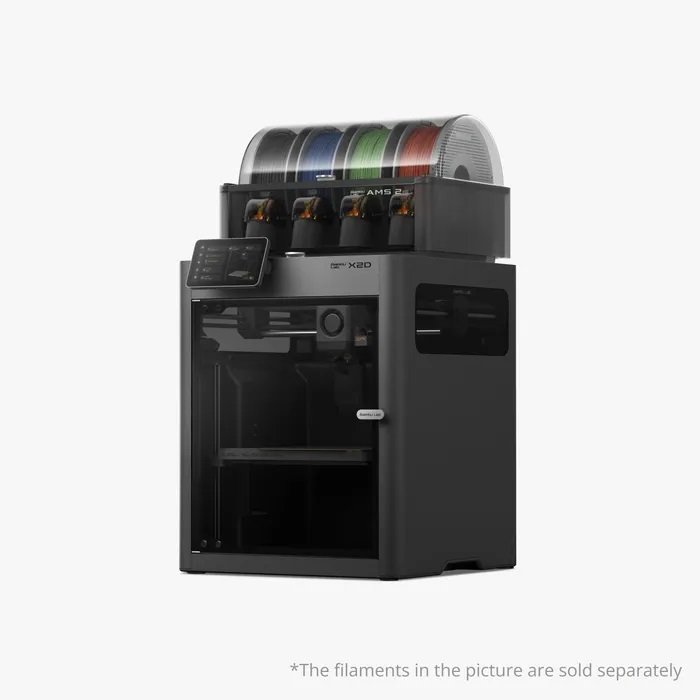
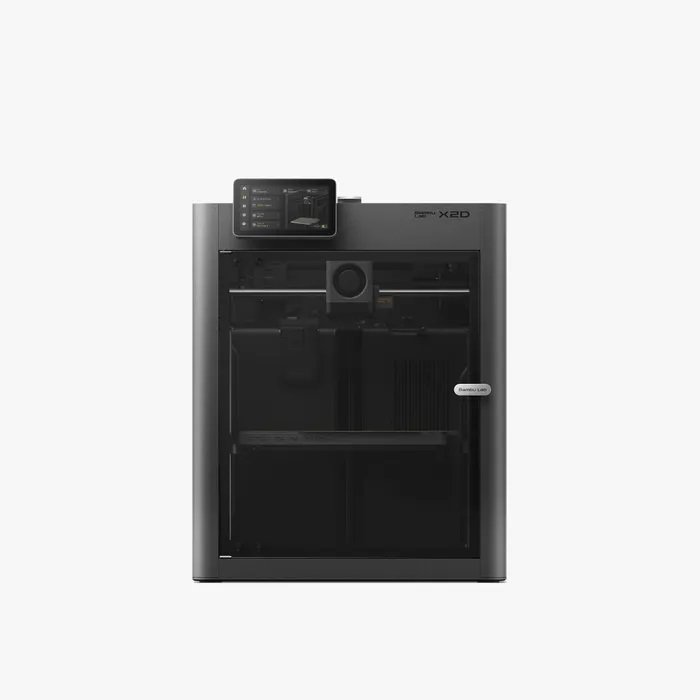
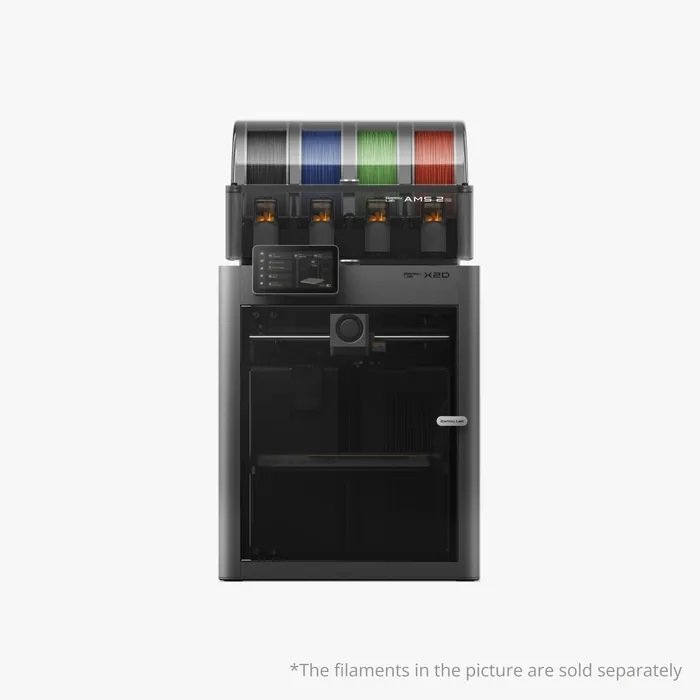
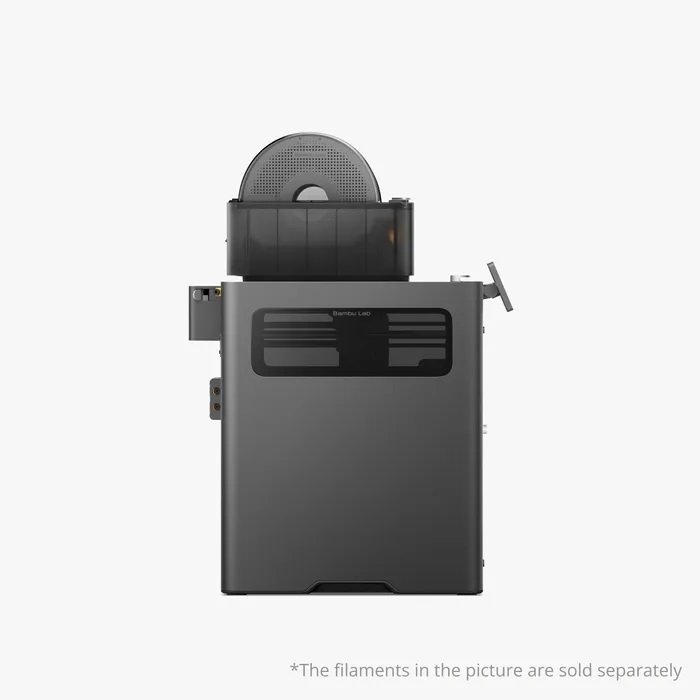
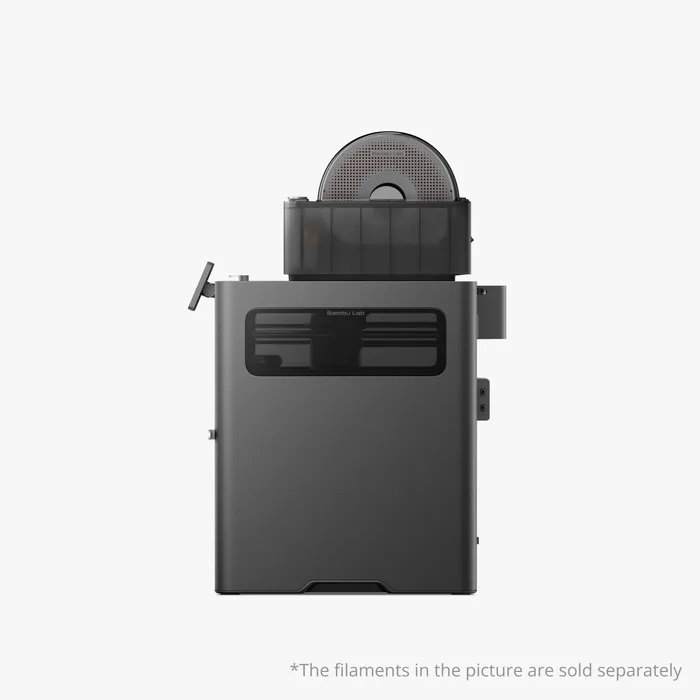
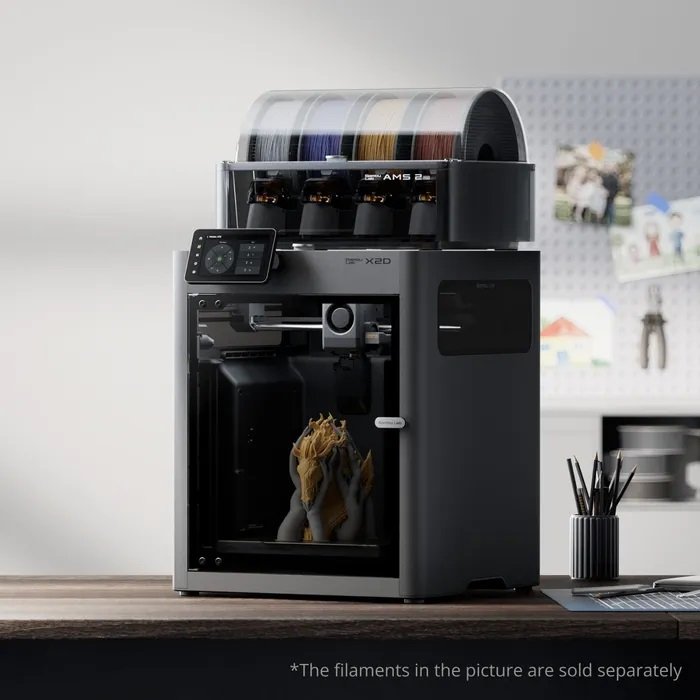
₨ 1,300,000 – ₨ 1,500,000Price range: ₨ 1,300,000 through ₨ 1,500,000
Product Features:
Your orders are shipped seamlessly between cities
You can return your orders within 5 days.
You can prchase product after testing.
Two intakes are always better than one. Freshly extruded filament is soft, but the X2D instantly flushes the chamber with cool air from dual left and right intakes. This constant air exchange stabilizes each layer for low-temperature filaments like PLA, cooling every line at exactly the right moment. So even on tricky angles, overhangs stay sharp and bridges stay clean.
The X2D pairs a 300 °C nozzle with a 65 °C actively heated chamber – hot enough for the majority of engineering filaments like ABS, ASA, and nylon. But temperature alone isn’t the point – the active chamber distributes heat evenly, so layers bond strongly from edge to edge. Your large engineering prints come out strong and flat.
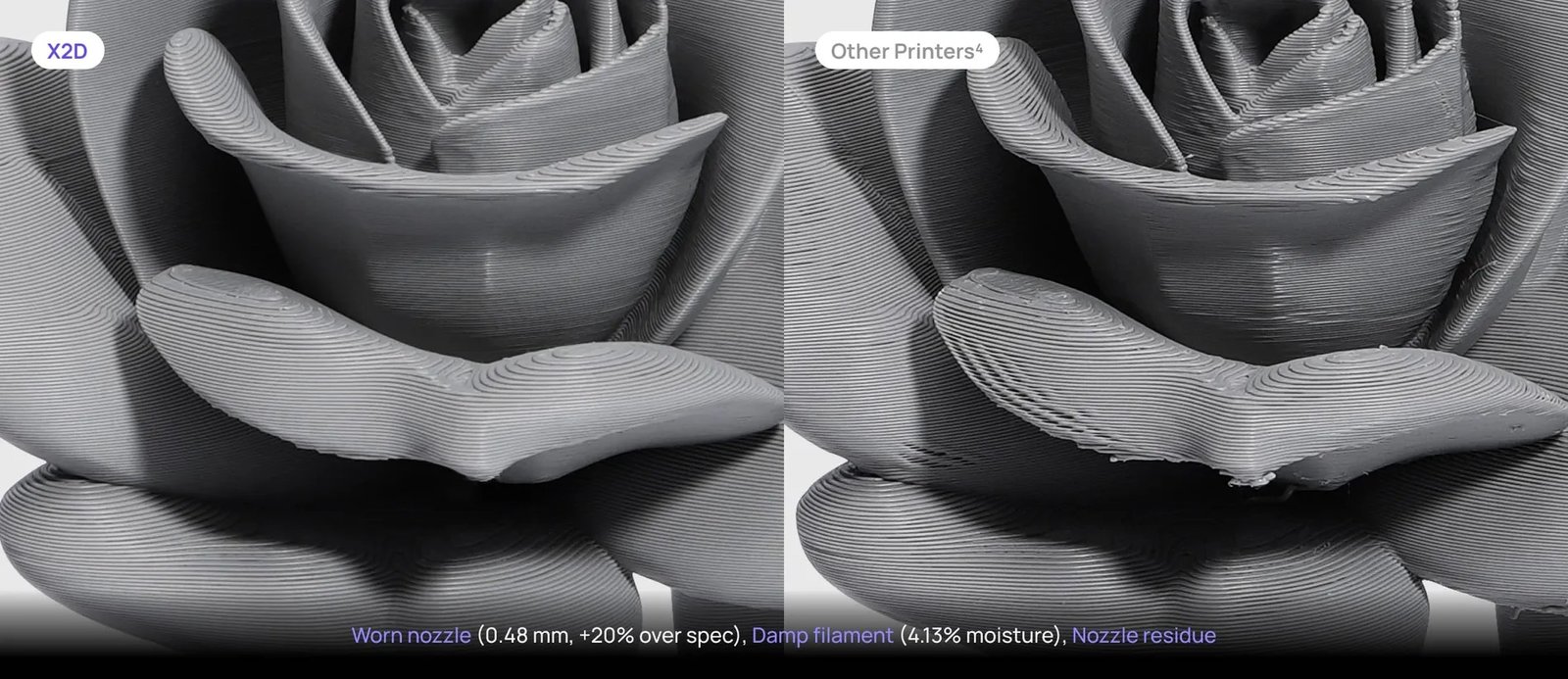
Most printers calibrate flow with a single K factor and use it in all scenarios. Bambu Lab doesn’t. Flow Dynamics Calibration³ builds a time-varying, nonlinear model of your entire extrusion system. So whether there’s minor residue inside the nozzle, gradual nozzle wear, or slightly damp filament, the system detects, calibrates, and compensates. Smooth surfaces and sharp edges stop being luck. They repeat.
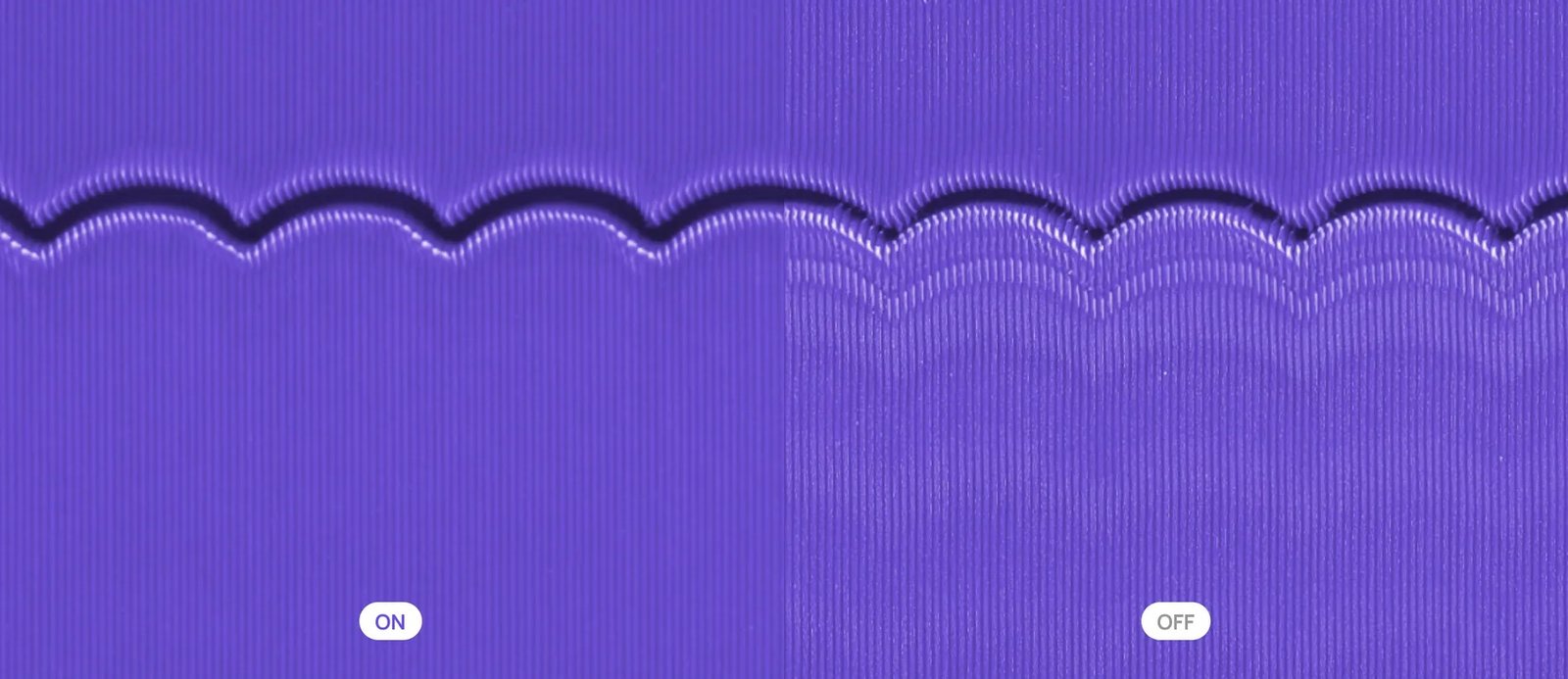
Extruder gears grind into filament as they feed it, causing small pressure fluctuations that show up as tiny lines on the surface. Exclusive to Bambu Lab, the PMSM servo system⁵ counters this in real time. With resistance and position sampling at 20 kHz, it adjusts electromagnetic torque on the fly, smoothing out every micro-fluctuation before it reaches the surface.
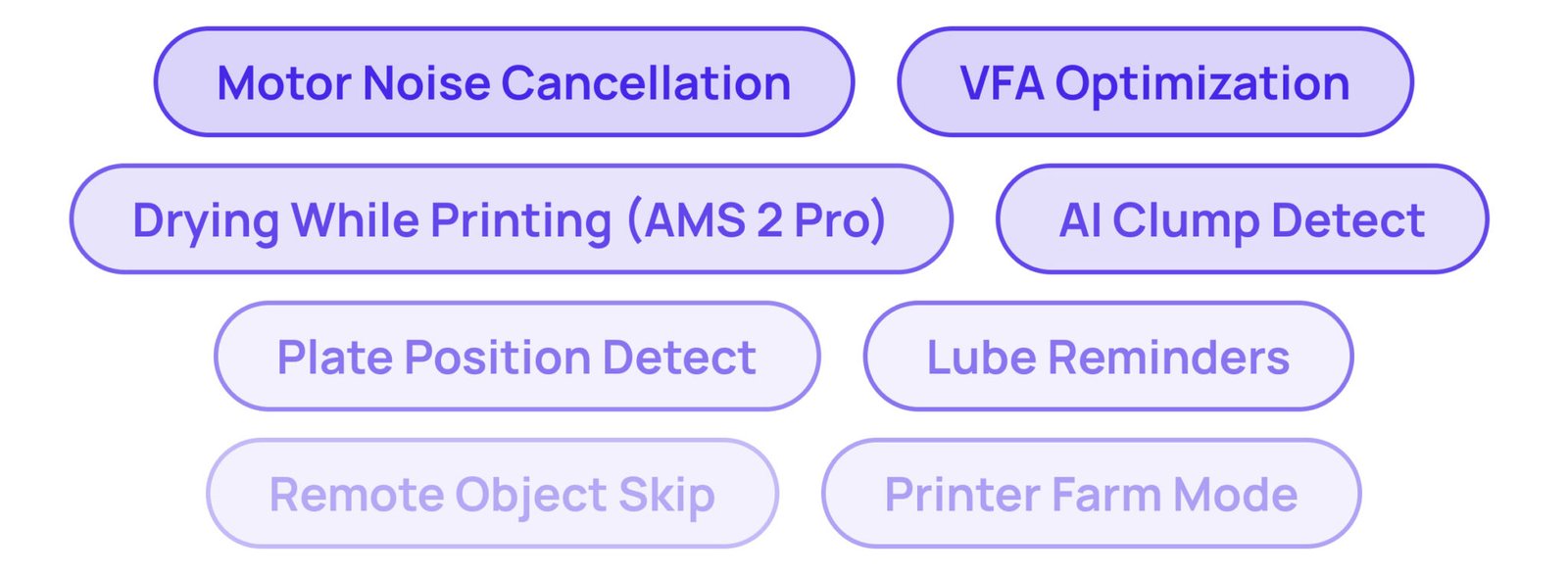
Ringing and ghosting blur edges at high speed. Active Vibration Compensation cancels them in real time – so edges print crisp, no matter how fast.
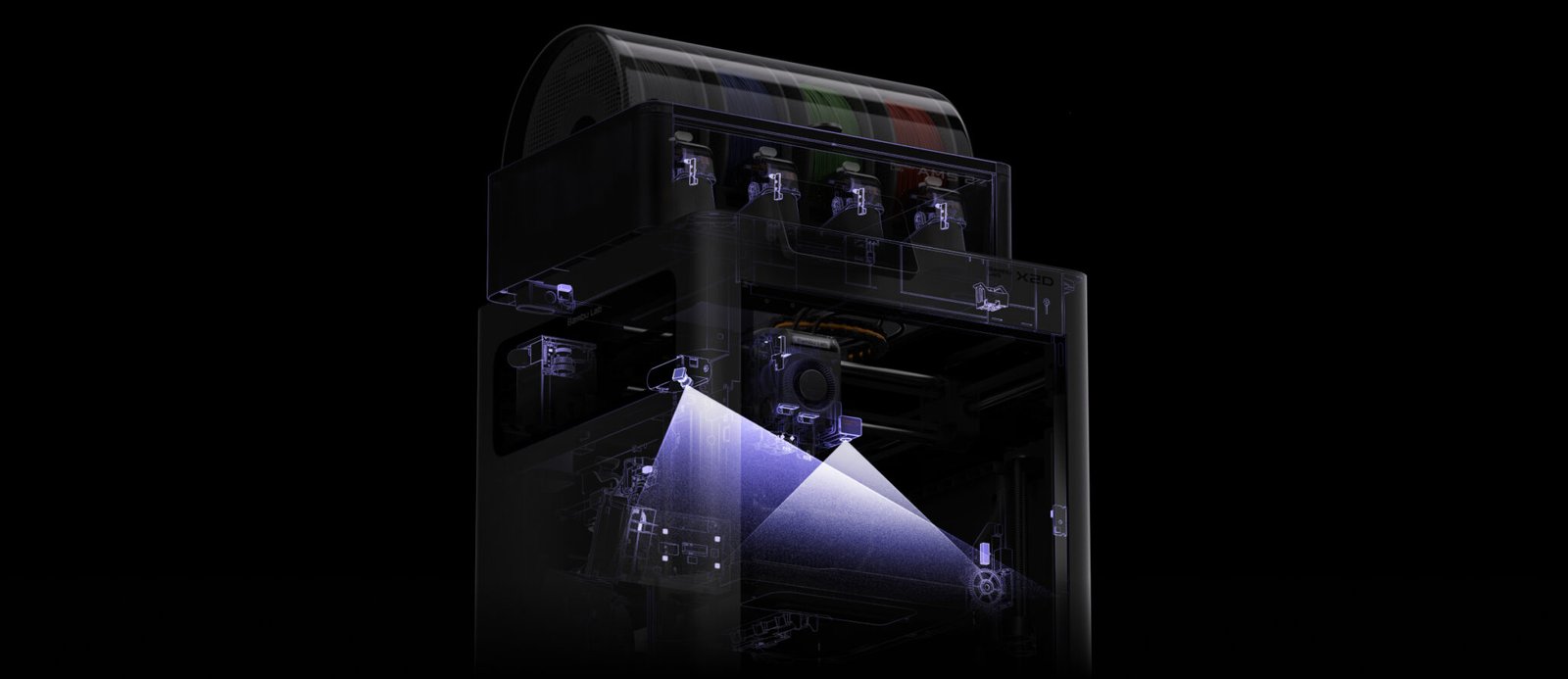
31 sensors span the entire system – monitoring the feeding path, printing process, thermal environment, and machine safety in real time. Every variable that affects your print is measured, checked, and acted on.
X2D prints beautifully the day it arrives. And it gets better with every update. Major firmware updates land roughly every three months⁸ – new features, better performance, all pushed straight to your machine.
| X2D | X2D AMS Combo | |
|---|---|---|
X2D 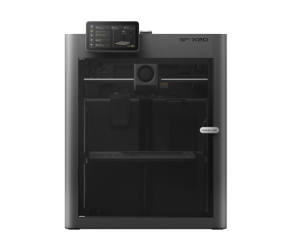 | ✓ | ✓ |
Textured PEI Build Plate 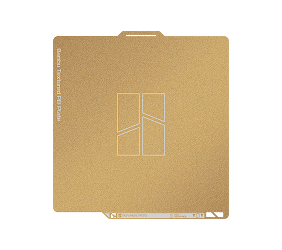 | ✓ | ✓ |
External Exhaust Fan Bundle 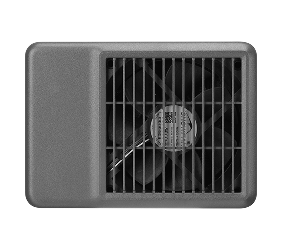 | ✓ | ✓ |
Accessory Box 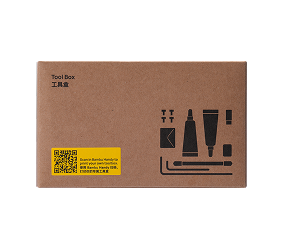 | ✓ | ✓ |
Spool holder 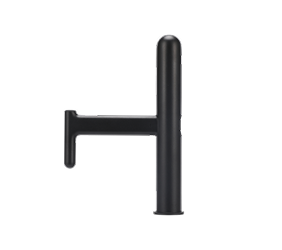 | ✓ | ✓ |
AMS 2 Pro (combo version) 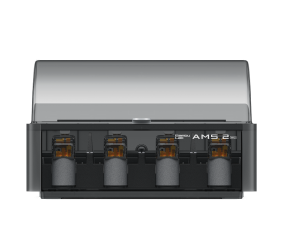 | – | ✓ |
Item | Specifications | |
| Printing Technology | Fused Deposition Modeling | |
| Body | Build Volume (W*D*H) | Main Nozzle Printing: 256*256*260 mm³ Auxiliary Nozzle Printing: 235.5*256*256 mm³ Dual Nozzle Printing: 235.5*256*256 mm³ Total Volume for Two Nozzles: 256*256*260 mm³ |
| Chassis | Plastic and Steel | |
Outer Frame | Plastic, Glass, and Metal | |
| Dimensions and Weight | Physical Dimensions | 392*406*478 mm³ Recommended printer space:500×700×850mm |
| Net Weight | 16.25 kg (Gross Weight: X2D 20.2 kg, X2D AMS Combo 22.2kg) | |
| Toolhead | Main Extruder Gear | Hardened Steel |
| Main Extruder Motor | Bambu Lab High-precision Permanent Magnet Synchronous Motor | |
Auxiliary Extruder Gear | Hardened Steel | |
Auxiliary Extruder Motor | Stepper Motor | |
| Nozzle | Hardened Steel | |
| Max Nozzle Temperature | 300 °C | |
| Included Nozzle Diameter | 0.4 mm | |
Supported Nozzle Diameter | 0.2 mm, 0.4 mm, 0.6 mm, 0.8 mm | |
| Filament Cutter | Built-in | |
| Filament Diameter | 1.75 mm | |
| Heatbed | Supported Build Plate Type | Textured PEI Plate, Smooth PEI Plate, Cool Plate SuperTack, Engineering Plate |
| Max Heatbed Temperature | 120 ℃ | |
| Speed | Max Speed of Toolhead | 1000 mm/s |
| Max Acceleration of Toolhead | 20,000 mm/s² | |
Max Flow for Hotend (Standard Flow Hotend) | 40 mm³/s (Test parameters: 250 mm round model with a single outer wall; Bambu Lab ABS; 280 °C printing temperature) | |
Max Flow for Hotend (Optional High Flow Hotend) | 65 mm³/s (Test parameters: 250 mm round model with a single outer wall; Bambu Lab ABS; 280 °C printing temperature) | |
Chamber Temperature Control | Active Chamber Heating | Supported |
Max Temperature | 65 °C | |
Air Purification | Pre-filter Grade | G3 |
HEPA Filter Grade | H12 | |
Activated Carbon Filter Type | Granulated Coconut Shell | |
VOC Filtration | Supported | |
Particulate Matter Filtration | Supported | |
Cooling | Part Cooling Fan | Closed Loop Control |
Cooling Fan for Hotend | Closed Loop Control | |
Main Control Board Fan | Closed Loop Control | |
Chamber Exhaust Fan | Closed Loop Control | |
Chamber Heat Circulation Fan | Closed Loop Control | |
Auxiliary Part Cooling Fan | Closed Loop Control | |
Filament Supported | Main Hotend | PLA, PETG, ABS, ASA, TPU, Support for PLA, Support for PLA/PETG, Support for ABS, Support for PA/PET, PET, PA, PC, PVA; Carbon/Glass Fiber Reinforced PLA, PETG, ABS, ASA, PA6, PAHT, PPA, PET |
Auxiliary Hotend | PLA (excluding PLA Aero), PETG, ABS, ASA, TPU for AMS, Support for PLA, Support for PLA/PETG, Support for ABS, Support for PA/PET, PET, PA, PC, PVA; Carbon/Glass Fiber Reinforced PLA, PETG, ABS, ASA, PA6, PAHT, PET | |
Auxiliary Hotend (print with caution¹) | PLA Silk, PETG-CF, ASA-CF, PA6-CF, TPU for AMS, Support for PA/PET | |
| Sensor | Live View Camera | Built-in; 1920*1080 |
Toolhead Camera | Built-in; 1600*1200 | |
| Door Sensor | Supported | |
| Filament Run Out Sensor | Supported | |
| Filament Tangle Sensor | Supported | |
| Filament Odometry | Supported with AMS | |
| Power Loss Recovery | Supported | |
Electrical Requirements² | Voltage | 100-120 VAC , 50/60 Hz |
Max Power³ | 1100 W@110 V | |
Steady-State Power | PLA (25 °C): 250 W@110 V PC (25 °C): 550 W@110 V Please purchase the version corresponding to your region’s voltage. Using the Printer in different regions, you may need to purchase a transformer accordingly. | |
Environment Requirements | Working Temperature | 10 °C-30 °C |
| Electronics | Touchscreen | 5-inch 1280*720 Touchscreen |
| Storage | Built-in 8 GB EMMC and USB Port | |
| Control Interface | Touchscreen, mobile App, PC App | |
Motion Controller | Dual-core Cortex-M4 and Single-core Cortex-M7 | |
Application Processor | Quad-core ARM with dedicated NPU | |
| Software | Slicer | Bambu Studio Supports third-party slicers which export standard G-code, such as Super Slicer, PrusaSlicer and Cura, but certain advanced features may not be supported. |
| Supported Operating System | MacOS, Windows, Linux | |
Network Control | Ethernet | Not Available |
Wireless Network | Dual-Band Wi-Fi | |
Network Kill Switch | Not Available | |
Removable Network Module | Not Available | |
802.1X Network Access Control | Not Available | |
| Wi-Fi | Operating Frequency | 2412 – 2472 MHz, 5150 – 5850 MHz (FCC/CE) 2400 – 2483.5 MHz, 5150 – 5850 MHz (SRRC) |
| Wi-Fi Transmitter Power (EIRP) | 2.4 GHz: <23 dBm (FCC); <20 dBm (CE/SRRC/MIC) 5 GHz Band1/2: <23 dBm (FCC/CE/SRRC/MIC) 5 GHz Band3: <30 dBm (CE); <24 dBm (FCC) 5 GHz Band4: <23 dBm (FCC/SRRC); <14 dBm (CE) | |
| Wi-Fi Protocol | IEEE 802.11 a/b/g/n | |
1)For optimal print quality, please use the main hotend to print these filaments.
2)The printer’s voltage specifications vary by sales region. Before use, please check the label next to the power socket on the printer to ensure the supplied voltage matches the indicated voltage.
3) To ensure the heatbed quickly reaches the needed temperature, the printer will maintain maximum power for about 3-5 minutes.
| Weight | N/A |
|---|---|
| Brand | |
| Types |


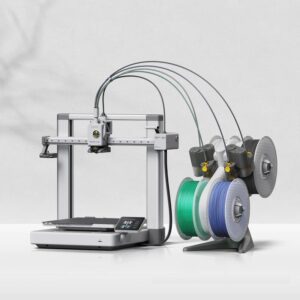


At Sky Heights, we specialize in innovative 3D printing solutions and high-quality accessories. Our mission is to bring your ideas to life with precision and creativity, offering cutting-edge technology for a wide range of applications. Whether you’re a hobbyist or a professional, Sky Heights has the tools and expertise to elevate your projects to new heights.


Reviews
There are no reviews yet.